
Compost Masculinity: Metabolizing Grief
Turning bracing into presence, and pain into soil

There’s a kind of masculinity that lives like the world is ending.
Not in the philosophical way. In the nervous system way.
The chest tightens before you even know why. The mind runs catastrophe math in the background. The body stays on a low simmer of readiness: ready to argue, ready to defend, ready to dominate, ready to disappear. And because that posture is exhausting, men learn the skills that make it feel sustainable: numb out, power up, distract, perform.
But here’s the quiet truth: a lot of what we call “strength” in men is just bracing dressed up as virtue.
Bracing is not courage. Bracing is a body trying to survive a world that doesn’t feel safe.
And in times that feel apocalyptic, be it politically, culturally, relationally, spiritually, the temptation is to double down on bracing and call it leadership. To harden and call it clarity. To become a weapon and call it protection. To keep scrolling and call it being informed. To keep winning and call it being alive.
But the question isn’t only, “Is the world falling apart?”
The deeper question is: What kind of man am I becoming while I watch it burn?
I asked this same question about being human over at We Can Stay Human:

The taking form: when men outsource grief into control
When fear rises, men are often recruited into what I’d call the taking form (Henri Nouwen called it that first), a way of being organized around control, scarcity, domination, contempt, and certainty. The taking form doesn’t always look like violence. Sometimes it looks like sarcasm. Sometimes it looks like obsession with productivity. Sometimes it looks like spiritual performance. Sometimes it looks like being the smartest person in the room. Sometimes it looks like being “unbothered.”
But underneath all of it is the same ache: grief that has nowhere to go.
Because when grief has no container, it doesn’t disappear. It leaks.
It leaks into rage. Into addiction. Into shutdown. Into porn. Into work. Into affairs. Into doomscrolling. Into conspiracy certainty. Into the need to be right. Into the need to win. Into the subtle, daily habit of dehumanizing people … especially the ones who threaten our sense of control.
And this is one of the most painful truths for men to face: Refusing grief doesn’t keep you strong. It makes you manipulable.
A man who can’t metabolize grief will keep reaching for anything that offers immediate relief: a villain, a scapegoat, a fantasy of domination, a hit of certainty, a quick dopamine loop. That’s not moral failure. It’s nervous system math.
But it is also formation. And it will shape a man into someone they don’t recognize.
Compost masculinity: a slow, unglamorous strength
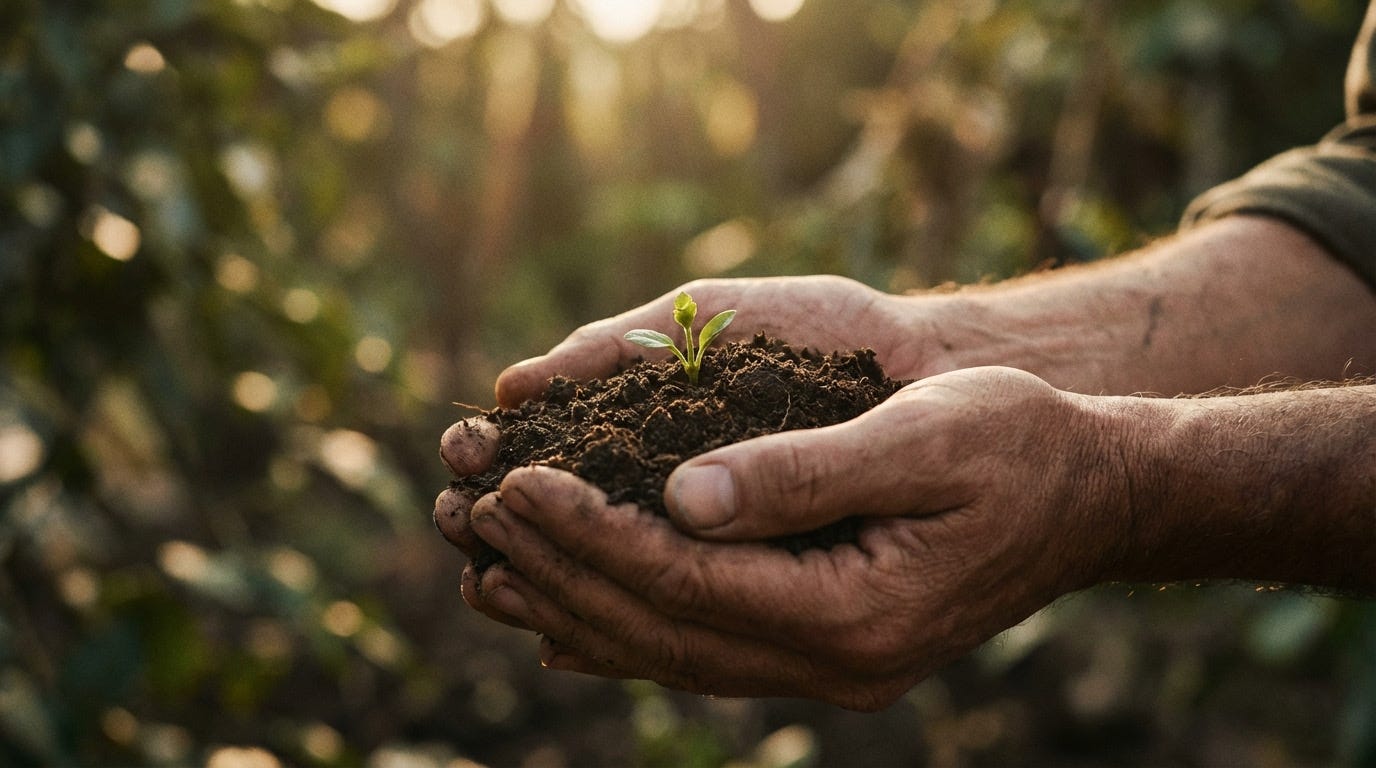
This is where I keep coming back to compost. Not as a cute metaphor. As a spiritual technology.
Compost is slow. Compost is unglamorous. Compost can smell. Compost doesn’t reward urgency. Compost is what happens when you stop pretending that what’s dying is useless, and you create conditions for transformation.
And in a culture that teaches men to treat grief like weakness, compost becomes a reimagining of strength: Compost masculinity is the strength to stay present with what’s rotting without becoming rot.
It’s the strength to feel sorrow without collapsing into self pity or outsourcing it into contempt. It’s the strength to name fear without turning it into control. It’s the strength to let something old die on purpose, (be it a persona, a performance, a coping strategy) so something truer can grow.
Compost masculinity is not softness as aesthetic. It’s tenderness as resistance.
It’s not passivity. It’s containment.
It’s not “I’m fine.” It’s “I’m here.”
Because grief is not just a feeling. Grief is a process of breakdown that makes room for truth. And truth is soil.
Why men avoid the compost pile
Men avoid compost for understandable reasons.
First, many men were taught that pain should be solved, not felt. So grief becomes a problem to fix, not a reality to metabolize. That creates a reflex: If I feel it, I’m failing.
Second, grief makes you porous. It makes you human. It exposes longing. And longing is risky. Longing admits you can’t control outcomes. Longing admits you love.
Third, grief takes time. And speed is one of the main drugs men are offered. The faster you move, the less you have to feel. The more efficient you are, the less room there is for the ache to speak.
But the cost of skipping grief is not neutrality. The cost is deformation. A man who can’t grieve will keep hardening. And a hardened man will call their hardness “strength,” even as it ruins their relationships, their body, and their spirit.
The alternative: the forgiving form
There’s another way of being in the world. Call it the forgiving form.
Not “forgiving” as in excusing harm. Forgiving as in refusing to let fear turn you into an instrument of the taking form.
The forgiving form moves through vulnerability, surrender, communion, creativity, and repair. It has boundaries. It has spine. But it doesn’t require dehumanization to function.
And compost masculinity belongs to the forgiving form. Because compost is a container. And men need containers.
Not just “insights.” Not just “content.” Not just “self - improvement.”
Containers: practices, relationships, rituals, therapy, coaching, prayer, time outside, honest conversations. The places where grief can break down safely into truth instead of leaking into destruction.
The man the world needs
We don’t need more men who can posture through collapse. We need men who can grieve without becoming cruel. Men who can feel fear without outsourcing it into domination. Men who can tell the truth without turning it into a weapon. Men who can stay present, especially when it would be easier to numb out or power up.
Compost masculinity is not glamorous. It will not get you applause. It’s often private. Unphotographed. Slow. But it grows something real.
And assuming the world keeps turning, tomorrow we will need soil. We will need community. We will need nervous systems that know how to rest. We will need men who know how to metabolize grief into love.
Plant the tree. Build the compost bin. Let the old become soil.
That’s not weakness. That’s manhood reimagined.
If you read this and find yourself needing to build a grief practice, this Saturday I’m launching a four-part Life After Loss course which will include videos, a workbook, rituals, and audio guides to not only make sense of the grief landscape but also help you build both a private and communal grief practice.
And if you send your email my way by Friday, I’ll send you a 50% off coupon code good for launch week. DM me here or sign up on my webpage.