
Why?
When “Why” Helps, and When It Hurts

There’s a certain kind of manhood that believes every problem has a lever. Find the lever, pull it, and the whole machine behaves.
So we’re drawn to “why.”
Simon Sinek says start with why, and that’s not wrong. The right “why” can be a lighthouse. It can give direction, coherence, motivation. It can keep you steady when discipline gets tired.
Sometimes, “why” is exactly the question.
The kind of “why” that heals
Lately I’ve been trying to get my cholesterol down. I’ve done the usual things: paying attention to food, movement, labs, trying to be faithful and patient.
But eventually you hit that moment: Not “What should I do next?” but “Why is this happening in the first place?”
Because if you can understand the cause, you might finally stop fighting shadows.
For me, it seems possible that there’s a deeper mechanism at play, a MTHFR gene mutation affecting methylation and how my body uses what it creates. (And to be clear: I’m still learning, still testing, still discerning, this isn’t medical advice, just my lived process.)
But the point is this: when I began addressing that potential why, supporting methylation with methylated B vitamins, SAMe, and related supports, something shifted. My early experience was a meaningful drop (around 30 points in about a month and a half), with more clarity likely coming.
That’s the gift of “why” when it’s the right question: it doesn’t just soothe curiosity. It changes outcomes.
It helps you cooperate with reality instead of wrestle it.
The kind of “why” that breaks you
But there are other places where “why” doesn’t heal. It only haunts.
This past weekend, I officiated the funeral for a young man who took his own life. It’s not the first time I’ve done it and I’m sure it won’t be the last.
And there is no “why” that makes a 26-year-old’s death okay.
Whether the story is suicide, murder, a blood clot, an accident, whatever the facts end up being, none of those explanations become a moral solvent. None of them dissolve the unbearable grief. None of them restore what was taken.
In some losses, “why” becomes a bargaining chip we keep trying to spend in a store that doesn’t accept that currency.
And if you keep insisting that it must, if you keep demanding a satisfying reason, you can end up doing violence to your own soul. Because you start to believe that peace is something you earn through explanation.
But some pain can’t be explained into peace.
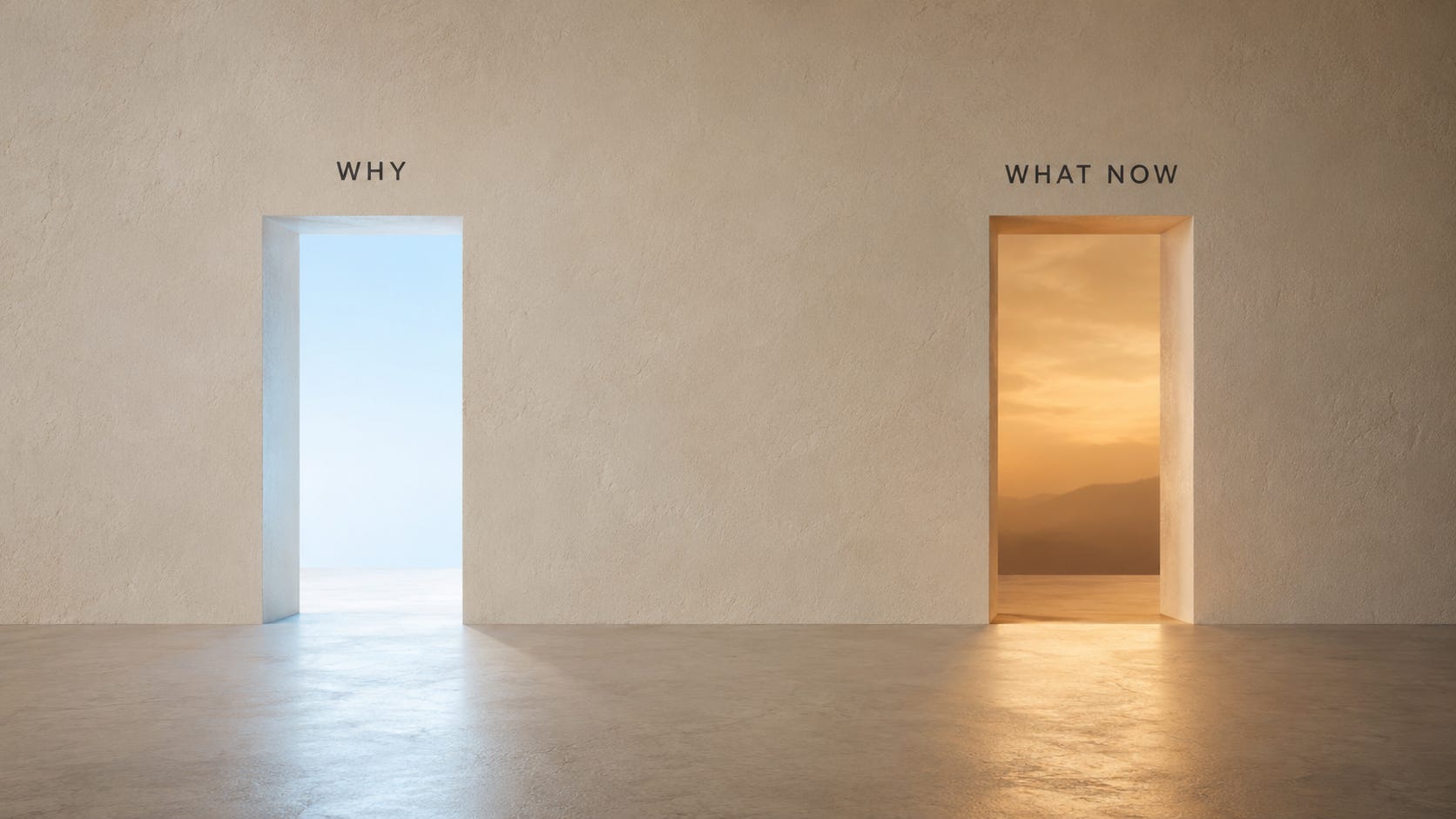
“Why” and “What now” are different spiritual practices
Maybe this is where wisdom lives: not in always asking “why,” but in learning to tell the difference between two kinds of suffering.
There’s suffering that is mechanical: cause and effect, inputs and outputs, patterns you can name and adjust.
And there’s suffering that is mystery: grief that refuses to fit inside language, loss that cracks your categories, sorrow that isn’t a puzzle to solve but a reality to carry.
The first kind often wants why.
The second kind demands a different question: What now?
What now do I do with this breath in my body?
What now does love look like in the aftermath?
What now is mine to hold, mine to release, mine to grieve, mine to repair?
“What now” doesn’t erase the ache. It doesn’t pretend the world makes sense.
It just refuses to let the ache make you numb, cruel, or alone.
The masculinity shift: from control to courage
A lot of us were trained, explicitly or subtly, to believe that a “real man” gets answers. A “real man” figures it out. A “real man” solves the problem.
But the deeper work is learning when problem-solving is actually avoidance. Sometimes “why” is an attempt to regain control over what has made you feel powerless.
And sometimes the most courageous thing a man can do is admit: “I don’t get a why that satisfies. And I’m still here.”
Not as resignation, but as devotion. Devotion to what’s real. Devotion to grief as love’s shadow. Devotion to the holy work of continuing.
Serenity as an adult spirituality
This is where the Serenity Prayer keeps finding me, not as religious nostalgia, but as mature wisdom:
The courage to change what can be changed.
The serenity to accept what cannot.
And the wisdom to know the difference.
In other words:
the wisdom to know when to ask why,
the humility to stop demanding why when it won’t save you,
and the courage to ask what now, and mean it.
Because some “whys” lead to healing. And some “whys” lead to a lifetime of chasing an answer that will never be big enough to hold your pain.
But “what now” is always available. “What now” is where agency returns, not as control, but as presence. Not as certainty, but as love.
A closing invitation
If you’re in a season where you can change things, ask why. Learn. Investigate. Get underneath the symptom. Be brave enough to tell the truth about your patterns.
And if you’re in a season where the pain is bigger than explanation, you’re not failing because you can’t find the reason. You’re human. Let “why” go, if it’s costing you your life. And ask the better question: What now?
What now do I do with this grief?
What now does tenderness look like?
What now does it mean to stay human?
If you need help processing through your what now, let’s talk.
I love the way you've delineated the differences between these questions. I believe this is always about finding the right questions for us -- not the easy answers. Questions push us forward. Answers often keep us where we are.
This just popped up in my feed, it made me think of this article and your cholesterol, so thought I'd share it. It's a good video, I should say I'm working with her at the moment, not on cholesterol issues though. She's very knowledgeable and deals well with a ton of questions from me 😊
https://youtu.be/q_v6qIuoA8k?is=EMRISYROnMur_A-x